|
Internet Courses |
|
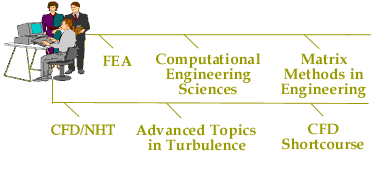
Internet provides the totally time- and distance-insensitive venue for academic outreach. Examine the following to ascertain their potential for meeting your needs in your time frame. Finite Element Analysis - ME 452w: A senior level undergraduate course introducing finite element analysis basics leading to computing practices. Finite element methodology converts weak for theory for engineering conservation principles with physics closure models into "computable form." ME 452w may be taken for credit or audit or for transfer credit by non-UT students admitted to their home university. It may also be taken for professional self-study directly through the UT CFD Laboratory (touch Collaboratory on the homepage). Your receiving site need have only a respectable PC with free software and a DSL or similar Internet connection. All course lectures are digitally archived, hence those missed or desired reviewed are available at anytime! Check out the open front end. Computational Engineering Sciences - ES 551w: A thorough graduate-level exposition to weak form methods for multi-disciplinary applications in the engineering sciences. Course focus is on mathematical underpinnings hence comparative assessment of finite element / difference / volume discrete implementations via computer practice for solution quality assessments. Piped directly to your home or office, you need to have only a decent PC with sound card, Real Player and connection to Internet. The course is complete with built-in courseware, random-accessible archived lectures via video-streaming, computer lab experiments archive. It's available anytime and anyplace for professional self-study, or in fall semester in a classroom environment. Check out the open front end. Computational Fluid-Thermal Sciences - ES 552w: US industry has a burgeoning need for engineers truely skilled in application of computational fluid dynamics and numerical heat transfer (CFD/NHT) methods to engineering design. And, they are willing to pay for your training! Ordinarily one would attend a one week short course, or a commerical code training course, to get underway. Now, via Internet video streaming, you have available a thorough MSc-level graduate course in modern CFD/NHT methodology, ported directly to your home or office! The course is complete with built-in text courseware, random-accesible archived lectures, and computer lab experiments via the UT CFD Lab aPSE (a Problem Solving Environment) research code. Help forming your decision by reviewing the course open front end. Advanced Topics in Turbulence - ES 645w: An advanced (PhD-level) topical course developing in completeness the mathematical foundations for CFD turbulence characterization . Fundamental content includes energy spectra, Kolmogorov stress tensor, eddy cascade structures, the concept of turbulent diffusion. Rearrangement of the Navier-Stokes PDE system via time averaging, Reynolds stress tensor, similarity solutions, algebraic and differential turbulence closure models for CFD applications. Space filtering the NS PDE system leading to large eddy simulation (LES) concepts/algorithms, filter function approximations, Fourier transforms, Reynolds stress tensor quadruple, approximations. Closure models from Smagorinsky to multi-scale dynamic models to analytically formulations via wavenumer asymptotics. Computer lab applications in external and internal flows. Check out the open front end. Matrix Methods - ChE 527: When it becomes archived, this course will present the fundamental principals of matrix algebra methodology applied to engineering systems analysis. The course will cover LU, QR, SVD and eigen decomposition of a matrix and the role each plays in forming the solution of discretized problem statements. The approach employs geometric understanding with physical interpretation of linear algebra manipulations as applied to analysis of systems, and the multivariate data, with respect to the degrees of freedom, input-output sensitivity and process operability. |