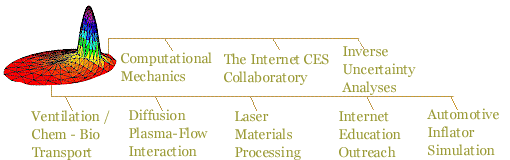
Current Research Projects
|
|
Computational Engineering Sciences: The CFD Laboratory graduate research focus emphasis has been fundamental theory developments in modified continuous Galerkin weak form methods. The goal has been generation of linear basis finite element discrete implementations exhibiting the accuracy/converge attributes the domain of higher degree basis constructions. The linear basis finite spatial semi-discretization is ultimately most efficient in parallel computing. Pivotal archival publications include: "A Modified Conservation Principles Theory Leading to an Optimal Galerkin CFD Algorithm," S. Sahu & A.J. Baker, J. Numerical Methods in Fluids, V. 55, p. 737 – 783, 2007. "Active Netlib: An Active Mathematical Software Collection for Inquiry-based Computational Science and Engineering Education," S. Moore, J.Dongarra, A.J. Baker, C Halloy & C Ng, J. Digital Information,, V. 2, Pt. 4, 2004. "A Modular Collaborative Parallel CFD Workbench," K.L. Wong & A.J. Baker, J. Supercomputing, V. 22, p.45-53, 2002. "An Efficient High Order Taylor Weak Statement Formulation for the Navier-Stokes Equations," A. Kolesnikov & A.J. Baker, J. Computational Physics, V. 173, p.549-574, 2001 "A 3-D Incompressible Navier-Stokes Velocity-Vorticity Weak Form FE CFD Algorithm," K.L. Wong & A.J. Baker, J. Numerical Methods in Fluids, V.38, p.99-123, 2001. "Numerical Simulations of Laminar Flow over a 3D Backward-Facing Step," P.T.Williams & A.J.Baker, J.Numerical Methods in Fluids, V.24, p.1-25, 1997. "Incompressible Computational Fluid Dynamics and the Continuity Constraint Method for the 3-D Navier-Stokes Equations," P.T.Williams & A.J.Baker, J.Numerical Heat Transfer, Part B, Fundamentals, V.29, p.137-273 (entire issue), 1996. "Incompressible Computational Fluid Dynamics and the Continuity Constraint Method for the 3-D Navier-Stokes Equations," P.T.Williams & A.J.Baker, J.Numerical Heat Transfer, Part B, Fundamentals, V.29, p.137-273 (entire issue), 1996. "On Taylor Weak Statement Finite Element Methods for Computational Fluid Dynamics," D.J.Chaffin & A.J.Baker, J.Numerical Methods in Fluids, V.21, p.273-294. 1995. Mass Transport: Theorize, develop and apply CFD algorithms/codes for prediction of mass transport in enclosed inhabited spaces with emphasis on indoor air quality (IAQ) and contaminant (chem/bio) transport assessment. Pivotal publications include:
Turbulence closure for CFD: Spatial filtering of the thermal Navier-Stokes conservation principles PDE system leads to a theory-identified quadruple of Reynolds stress tensors/heat flux vectors requiring identification for closure. Wavenmuber asymptotics with approximate deconvolution achieves analytical PDE closure for three of the four tensors/vectors. The optimal modified continuous Galerkin theory provides analytical closure replacing the wavenumber theory insignificant subfilter scale (SFS) tensor/vector. Implementation of this theory in parallel computing practice for validation is the dissertation topic of Mr. Sekachev.
Internet Academic
Outreach: The CFD Lab graduate academic curriculum
moved to the Internet a decade ago employing lecture video
streaming from a dedicated website archive. Pivotal publications include:
|